
Equipments
/Electronics
Night Vision Devices: Types and Technologies
Explore the basics of night vision technology and the different types of night vision devices, including goggles, cameras, binoculars, monoculars, and scopes.
4 min read
Advertisement
Table of Contents
This article explores the differences between image intensifiers and thermal imagers, two key technologies used in night vision devices. Both enable vision in low-light conditions, overcoming the limitations of the human eye in environments with reduced spectral range and intensity. These technologies are crucial in applications like surveillance, security, navigation, hunting, and wildlife observation, and are incorporated into devices such as cameras, goggles, scopes, and binoculars.
This multi-stage process results in an intensified image that is significantly brighter than the original, low-light image. Image intensifier technology has evolved through several generations (e.g., generation-0, generation-1, generation-2, generation-3, generation-3+, and generation-4), each offering improvements in performance and clarity.
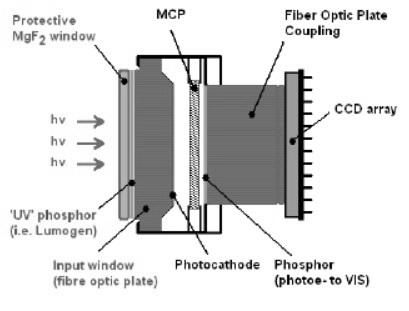
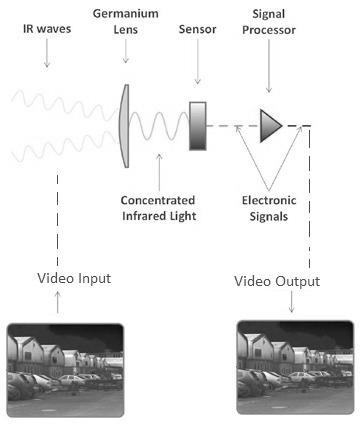
Thermal imagers allow users to “see” heat signatures, making them invaluable in situations where visible light is absent or obscured. They are used in a wide range of applications, including detecting heat leaks, identifying people in the dark, and monitoring equipment temperatures.
| Feature | Image Intensifier | Thermal Imager |
|---|---|---|
| Principle | Image intensification | Thermal imaging |
| Light Requirement | Requires some ambient light | Operates in complete darkness |
| Sensor Type | Photo-cathode and MCP | IR detector array |
| Image Basis | Amplified visible and near-IR light | Heat signatures/temperature differences |
| Typical Cost | Generally less expensive than thermal imagers | Generally more expensive than image intensifiers |
| Output Image | Enhanced view of existing light sources | False-color map based on thermal radiation |
| Ideal Use Case | Low-light observation | Complete darkness, heat-signature detection |
This comparison highlights the distinct advantages of each technology. Image intensifiers excel at amplifying existing light, while thermal imagers provide vision based on heat signatures, offering unique capabilities for various applications.
Advertisement
Equipments
/Electronics
Explore the basics of night vision technology and the different types of night vision devices, including goggles, cameras, binoculars, monoculars, and scopes.
Equipments
/Electrical
Explore the fundamentals of thermal cameras, their specifications, and a list of leading manufacturers, focusing on applications in electrical inspections.
Equipments
/RF
Explore RF frequency counters, their block diagrams, down-conversion techniques for microwave frequencies, and key specifications for selection.