
Measurements
/General
Flow Measurement Methods and Instruments
Explore various flow measurement methods, including variable head, variable area, and instruments like Venturimeters, Orifice meters, and Ultrasonic flowmeters.
2 min read
Advertisement
Table of Contents
This article explores the distinctions between laminar flow, turbulent flow, and transitional flow, highlighting their key characteristics and how they relate to the Reynolds number. When it comes to fluid motion in pipes, we generally observe these three types of flow:
Let’s delve into each one.
In laminar flow, the fluid moves in smooth, parallel layers, also known as streamlines. These layers don’t mix as they travel along the flow’s direction. Imagine a calm river flowing steadily – that’s a good visual for laminar flow.
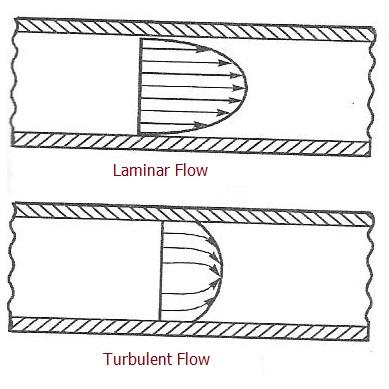
Turbulent flow, on the other hand, is characterized by chaotic and random fluid movement. Instead of neat layers, the fluid swirls and eddies, with the average motion going parallel to the pipe axis. This type of flow is more like a rapidly flowing, choppy river. The image above visually contrasts laminar flow with turbulent flow.
Transitional flow represents a middle ground. In this case, you might find regions of both laminar and turbulent flow within the pipeline. The flow might even switch between these states intermittently. It’s not as neatly defined as the other two.
The Reynolds number (Re) is a crucial dimensionless quantity that helps us predict the type of flow. It’s essentially a ratio of inertia forces to viscous forces in the fluid.
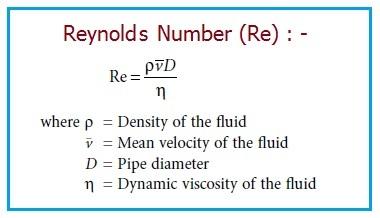
The Reynolds number is calculated based on fluid properties. It does not account for factors like pipe roughness, bends, or valves. The equation is shown in the image above.
Here’s how the Reynolds number determines the type of flow:
In summary, understanding these three types of flow, and how the Reynolds number influences them, is fundamental in fluid dynamics and various engineering applications.
Advertisement
Measurements
/General
Explore various flow measurement methods, including variable head, variable area, and instruments like Venturimeters, Orifice meters, and Ultrasonic flowmeters.
Measurements
/Flow
This article compares swirl and vortex flowmeters, highlighting their operating principles, accuracy, and suitability for different applications.
Measurements
/Flow
Explore the pros and cons of differential pressure flowmeters, a common technology for measuring fluid flow rates. Learn about their versatility and limitations.