
Articles
/General
USB, Ethernet, and Firewire: A Comparison of Connection Interfaces
This article compares USB, Ethernet, and Firewire, detailing their speeds, applications, and key differences to help users choose the right interface.
2 min read
Advertisement
Table of Contents
Thunderbolt is a hardware interface that lets you connect external devices to your computer or laptop. It’s designed to be fast and versatile, supporting daisy-chaining of up to six devices, allowing them to communicate with each other. You can use copper cables up to about 3 meters (10 feet) long, or optical fiber cables for distances up to 60 meters (200 feet). Intel developed Thunderbolt, and it essentially combines the power of PCI Express and DisplayPort technologies. It delivers a maximum voltage of 18V, a maximum current of 550mA, and a maximum power of 9.9W.
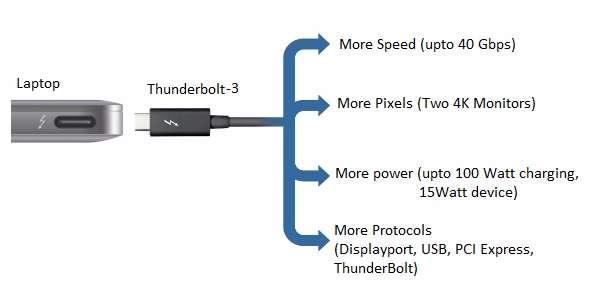
The latest version, Thunderbolt 3, is a major upgrade. Not only does it offer much faster data transfer, but it also supports two 4K displays at 60Hz. It can provide or draw up to 100 Watts of power. What’s more, Thunderbolt 3 uses the USB 3.1 Gen 2 Type-C connector, which adds great flexibility and ease of use.
Here’s a detailed comparison:
| Specifications/Features | Thunderbolt-1 | Thunderbolt-2 | Thunderbolt-3 |
|---|---|---|---|
| Connector type | Mini display port | Mini display port | USB Type-C |
| Number of pins | 20 | 20 | 24 |
| Bit Rate | 10 Gbps per channel, 20 Gbps total | 20 channels each supports 1 Gbps, 20 Gbps total | 40 Gbps |
| Protocol compliance | 4 x PCI express 2.0; display port 1.1a | 4 x PCI express 2.0; display port 1.2 | 4 x PCI express 3.0; display port 1.2; HDMI 2.0; USB 3.1 GEN-2 |
Advertisement
Articles
/General
This article compares USB, Ethernet, and Firewire, detailing their speeds, applications, and key differences to help users choose the right interface.
Articles
/Electronics
A comparison of VME and PXI buses, highlighting their differences in features, performance, and applications.
Articles
/Wireless
This article explores the MIPI RFFE interface, comparing v1.0 and v2.0, highlighting key differences like speed, master support, and interrupt capabilities.