
Articles
/General
Absolute vs. Specific vs. Relative Humidity: Key Differences Explained
This article clarifies the differences between absolute, specific, and relative humidity, explaining their definitions, formulas, and key characteristics.
2 min read
Advertisement
Table of Contents
This page provides information on understanding and using a Relative Humidity Table or Chart. It explains the steps to determine the relative humidity value using a table or chart based on dry bulb and wet bulb temperatures.
For a deeper understanding of the different types of humidity, you can explore the difference between relative humidity, absolute humidity, and specific humidity.
Here’s an example of what a Relative Humidity Table or Chart looks like:
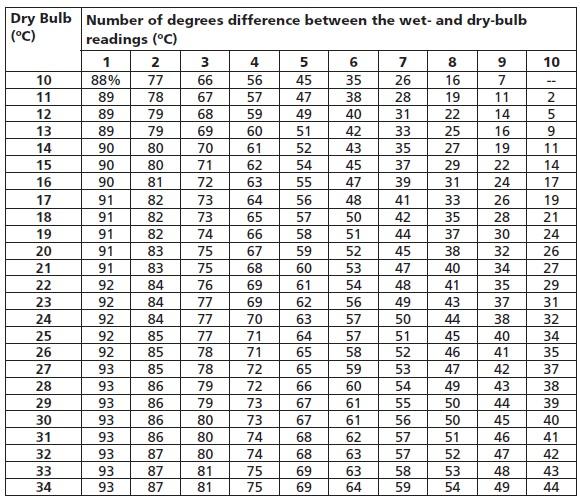
Here’s a step-by-step guide to reading the table or chart:
Step 1: Record Temperatures
Step 2: Calculate the Temperature Difference
Step 3: Find the Values on the Chart/Table
Step 4: Identify the Intersection
Step 5: Determine the Relative Humidity
Relative humidity tables and charts serve as essential tools in climate control, agriculture, manufacturing, and meteorology. They help in following:
By interpreting humidity charts correctly, industries and individuals can make informed decisions to maintain ideal environmental conditions and prevent potential damage due to excess or insufficient moisture.
Advertisement
Articles
/General
This article clarifies the differences between absolute, specific, and relative humidity, explaining their definitions, formulas, and key characteristics.
Terminology
/General
Explore the difference between dry and wet bulb temperatures, their measurement methods, and their significance in understanding air moisture content.
Terminology
/General
Understanding the differences between dry bulb temperature, air temperature, and dew point, and how they relate to humidity.