
Articles
/Wireless
IoT Testing Types: A Guide to Device Testing and Certification
Explore the crucial testing types for IoT devices, covering reliability, RF, protocol, regulatory, and interoperability aspects.
4 min read
Advertisement
Table of Contents
Wi-Fi testing is essential to ensure seamless performance, compliance with standards, and reliable interoperability across various devices and networks. RF/PHY conformance testing validates signal integrity, transmission power, modulation accuracy, and spectrum efficiency. Protocol compliance testing ensures adherence to IEEE 802.11 standards, including MAC layer operations, security protocols, and QoS (Quality of Service) mechanisms. Interoperability testing guarantees smooth communication between devices from different manufacturers, preventing connectivity issues in real-world deployments.
This article delves into the world of WiFi testing, covering essential aspects such as radio conformance, protocol conformance, and interoperability. This information is valuable for WLAN device manufacturers, WiFi software developers, and test & measurement companies.
The term “WiFi” refers to the technology managed and developed by the WiFi Alliance, based on the IEEE 802.11 family of standards. Various versions exist, each with different data rates, ranges, carrier frequencies, bandwidths, and system requirements. Table 1 provides a glimpse into some key parameters of different 802.11 standard versions.
| WLAN Standard | Frequency | Bandwidth | Data Rate |
|---|---|---|---|
| 802.11a | 5.3, 5.8 GHz | 20 MHz | 54 Mbps |
| 802.11b | 2.4 GHz | 20 MHz | 11 Mbps |
| 802.11g | 2.4 GHz | 20 MHz | 54 Mbps |
| 802.11n (Wi-Fi 4) | 2.4 GHz or 5GHz | 20 MHz or 40 MHz | 248 Mbps (2 MIMO streams) |
| 802.11ac (Wi-Fi 5) | 5 GHz | 20/40/80/160 MHz | Data varies based on BW and streams |
| 802.11ax (Wi-Fi 6) | 2.4 GHz, 5 GHz | 20/40/80/160 MHz | 9.6 Gbps (8x8 MU-MIMO & OFDMA) |
| 802.11be (WiFi 7, Upcoming) | 2.4, 5, 6 GHz | 20/40/80/160/320 MHz | 46 Gbps (16x16 MIMO & Multi-Link Operation) |
A typical WLAN system consists of two types of devices: a Client or Station, and an Access Point (AP) or Router. The AP provides the interface to the internet backbone, and all stations access the internet through it. WLAN devices are tested in both Infrastructure and Ad-hoc modes to ensure they can function in both network types.
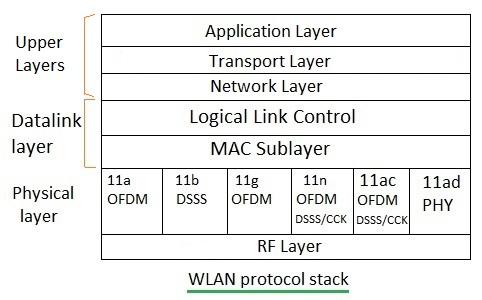
Below is the typical WLAN protocol stack. The modulation technique at the PHY layer and the RF carrier frequency/bandwidth vary depending on the specific standard.
Radio conformance testing validates the RF and Physical (baseband) layers of a WLAN device against the standard specifications. These tests are crucial for pre-compliance and pre-certification, ensuring a device meets the necessary requirements before formal certification. The primary goal is to verify that the device performs within the required RF and PHY layer limits for efficient WLAN operation.
For 802.11a/b/g, SISO (Single Input Single Output) tests are conducted. For 802.11n/ac/ad, both SISO and MIMO (Multiple Input Multiple Output) tests are necessary.
The main objective of protocol conformance testing is to verify the MAC layer and higher layers against the standard’s requirements. This includes ensuring all MAC control and management messages are simulated and work as expected. Furthermore, it tests the stability of data connections over both short and extended periods.
A WLAN MAC frame consists of a MAC header, a frame body containing MAC messages or data, and a Frame Check Sequence (FCS). MAC analyzer or sniffer applications are used to analyze and decode MAC frames, displaying their parameters. MAC frame generator applications are used to configure different MAC layer frames, enabling the testing of functionalities like Association Request/Request, Authentication, Beacon, Probe, etc.
Interoperability testing ensures that products from different vendors can coexist and function together seamlessly within a WLAN network. For instance, this test verifies that a WLAN station from one manufacturer (e.g., Linksys/Cisco) can connect to a WLAN router from another (e.g., D-Link), and vice versa.
Comprehensive Wi-Fi testing using spectrum analyzers, network emulators, and OTA (Over-the-Air) chambers ensures that devices deliver optimal performance, maintain regulatory compliance, and provide a seamless user experience.
As Wi-Fi technology evolves with Wi-Fi 6, 6E, and Wi-Fi 7, advanced testing methodologies will play a crucial role in enhancing efficiency, reducing latency, and supporting high-speed data transmission in next-generation wireless networks.
Advertisement
Articles
/Wireless
Explore the crucial testing types for IoT devices, covering reliability, RF, protocol, regulatory, and interoperability aspects.
Equipments
/Wireless
Overview of WLAN test equipment including RF testers (VSG, VSA) and protocol analyzers for conformance and pre-certification testing.
Measurements
/Wireless
This article explores 5G UE conformance testing, covering RF, RRM, and OTA tests, and the equipment used to ensure devices meet 3GPP standards.