
Terminology
/General
Understanding Resistivity: A Guide to Material Properties
This article explains resistivity and resistance, detailing how they impact electrical flow. Includes a table with resistivity values for various materials.
2 min read
Advertisement
Table of Contents
This article explains the concept of the Temperature Coefficient of Resistance, providing a calculator and the formula used for its calculation.
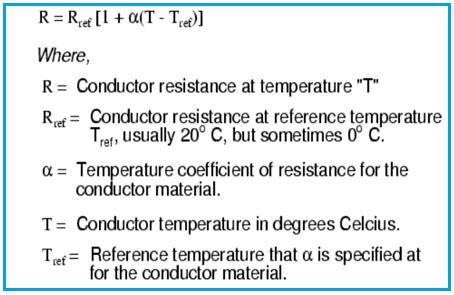
The table below shows the temperature coefficient of resistance for some common materials:
| Material | Value of α |
|---|---|
| Copper | 0.0043 / °C |
| Nickel | 0.0062 / °C |
| Constantan | 0 |
| Aluminium | 0.0038 / °C |
| Carbon | -0.00048 / °C |
| Eureka | 0.00001 / °C |
The following formula is used by the calculator to compute the Temperature Coefficient of Resistance:
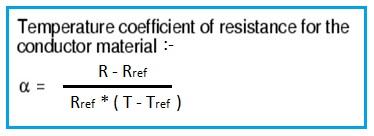
This calculator determines the Temperature Coefficient of Resistance using the equation provided below.
Inputs:
Output:
Example:
Let’s say:
Output: α = 3.92 x 10⁻³ (°C)-1 or 0.00392 (°C)-1
Advertisement
Terminology
/General
This article explains resistivity and resistance, detailing how they impact electrical flow. Includes a table with resistivity values for various materials.
Calculators
/Electronics
Calculate wire resistivity using resistance, length, and cross-sectional area. Learn about resistivity and the formula used.
Measurements
/Temperature
Explore the differences between Pt100 and Pt1000 RTDs, including resistance at 0°C and 100°C, and sensitivity.