
Articles
/Medical
ECG, EEG, and EMG: Advantages and Disadvantages
Explore the advantages and disadvantages of ECG, EEG, and EMG, three crucial biomedical tests for assessing the heart, brain, and muscles.
4 min read
Advertisement
Table of Contents
ECG (Electrocardiography), EEG (Electroencephalography) and EMG (Electromyography) are essential diagnostic tests used to assess the electrical activity of different physiological systems. This article compares ECG, EEG, and EMG machines, highlighting the key differences between them. We’ll also cover the ECG test, EEG test, and EMG test, and how they’re conducted using their respective machines.
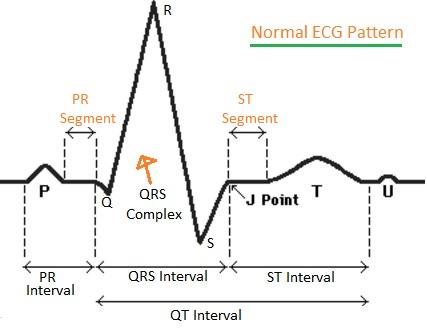 Figure 1: ECG test waveforms
The image above depicts waveforms in a normal ECG pattern. This pattern repeats continuously on the screen of the ECG machine. Probes, placed on the patient’s body, connect to the ECG machine. A total of 10 electrodes are used during an ECG test: 4 are connected to the left/right arms and left/right legs, while 6 are placed on the chest. These 10 electrodes constitute 12 leads.
As shown in the image, the ECG consists of a P wave, QRS complex, T wave, and U wave. The following are normal intervals (in milliseconds) that help in interpreting or reading the ECG test report:
Each second is equivalent to 250 ms (i.e., 5 squares of larger size). The following table mentions the number of large-size squares and their interpretation regarding Heart Rate (HR).
| Number of Large size squares | Heart rate |
|---|---|
| 5 | 60 beats per minute |
| 3 | 100 beats per minute |
| 2 | 150 beats per minute |
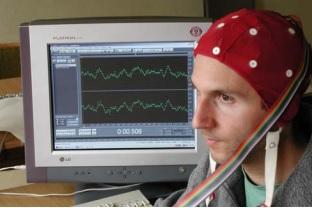 Figure 2: EEG test
 Figure 3: EEG Bands
The EEG test generates waves known as brain waves. These are divided into four major groups based on frequency range, also referred to as EEG bands. These bands help in analyzing different brain conditions based on age in the EEG test report:
An EEG test report can be used for:
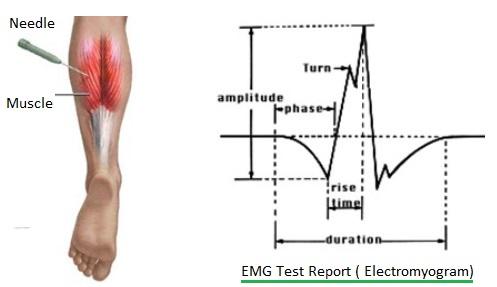 Figure 4: EMG electromyogram
ECG, EEG and EMG tests rely on electrodes to measure bioelectrical signals but they serve distinct purposes as follows. Each test plays a critical role in medical diagnostics, providing valuable insights into cardiovascular, neurological and muscular health. The choice of test depends on the symptoms and the system being examined.
Advertisement
Articles
/Medical
Explore the advantages and disadvantages of ECG, EEG, and EMG, three crucial biomedical tests for assessing the heart, brain, and muscles.