
Equipments
/Electronics
Understanding Sound Level Meters: Basics, Types, and Manufacturers
Learn about sound level meters (SLMs), their types (integrating, Class 1/2, Type 0/1/2), applications, and leading manufacturers in the industry.
4 min read
Advertisement
Table of Contents
This article delves into the topic of noise pollution, providing an overview of noise dosimeter equipment and the process known as noise dosimetry (the measurement of noise radiation). We’ll explore benefits of noise dosimeter and will go through features of prominent noise dosimeters from various vendors.
The term “noise” generally refers to any unwanted sound energy produced by a vibrating body. Sound energies can be categorized into two types: audible and unaudible.
Audible sound falls within the frequency range of 20Hz to 20KHz. Sounds with frequencies below 20Hz are known as infrasonic, while those above 20,000 Hz (20KHz) are called ultrasonic.
Noise can be continuous or intermittent, and can also be classified as high frequency or low frequency. In any system, noise can be thought of as having three elements: the source, the transmission path, and the receiver.
Noise originates from various sources, including:
While numerous sources contribute to noise, road traffic is often considered a primary source of noise pollution.
Noise levels are typically measured in decibels (dB) or A-weighted decibels (dB(A)), where dB(A) represents A-Weighted Sound Pressure Levels (SPL). Noise pollution occurs either at the source or along the transmission path before reaching the receiver.
Several techniques can be employed to control noise pollution:
The following table outlines various noise level measurement equipment and their specific functions:
| Noise level measurement equipment | Functional usage |
|---|---|
| Sound level meter (SLM) | Type-0: Lab reference standard, Type-1: Lab and field use in controlled environments, Type-2: General field use, Type-3: Noise survey |
| Impulse meters | Measures impulse noise levels, such as hammer blows |
| Frequency analyzers | Used with filters for design and analysis |
| Graphic recorders | Used with SLMs to plot SPL (Sound Pressure Level) over time |
| Noise dosimeter | (See detailed description below) |
| Calibrator | Checks the accuracy of SLMs |
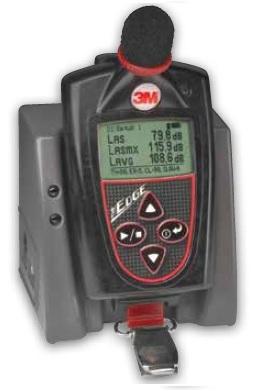
Here are some specifications of the 3M noise dosimeter (e.g., model eg5-D):
The table below lists several noise dosimeter vendors and their products:
| Noise Dosimeter, company | Description |
|---|---|
| FLIR Systems India Pvt. Ltd. | Extech SL400, used to test noise exposure levels, supports USB interface, compact and light weight |
| Pulsar Instruments Plc. | doseBadge |
| 3M | Noise dosimeters used for noise dosimetry as mentioned above. |
| Noise Meters Inc. | Manufactures sound level meters, dosimeters, noise monitors and controllers, dust meters, vibration meters, etc. |
| Casella CEL Inc. | Models 350, 352 plus dosimeters and accessories |
Following are some of the advantages of noise dosimeter.
A Noise Dosimeter is an essential tool for monitoring and managing occupational noise exposure, ensuring worker safety, regulatory compliance, and effective noise control. By providing real time and long term noise measurement, it helps industries prevent hearing damage, implement protective measures, and create safer work environments. Its portable and user friendly design makes it a valuable asset in health & safety management across various industries.
Advertisement
Equipments
/Electronics
Learn about sound level meters (SLMs), their types (integrating, Class 1/2, Type 0/1/2), applications, and leading manufacturers in the industry.
Equipments
/RF
Explore the principles, operation, and applications of noise figure meters, including leading vendors and manufacturers.
Equipments
/RF
A comparative analysis of spectrum analyzers from Keysight, Tektronix, and Rigol, highlighting key specifications and features for RF applications.