
Measurements
/Wireless
5G UE Conformance Testing: OTA Tests & Equipment
This article explores 5G UE conformance testing, covering RF, RRM, and OTA tests, and the equipment used to ensure devices meet 3GPP standards.
2 min read
Advertisement
Table of Contents
This page provides an overview of 5G BTS Conformance Testing. It explores various 5G BTS OTA (Over-The-Air) test cases conducted using 5G BTS (i.e., Base Station) conformance test equipment.
Any communication system is fundamentally composed of two parts: a transmitter and a receiver. The signal generated by the transmitter, known as the transmit signal, inevitably undergoes various impairments (like nonlinearities and noise) as it travels through the transmit chain’s modules. Similarly, the received signal isn’t perfect; it also contains distortions and impairments. Due to these imperfections, it’s essential to perform thorough testing on devices throughout their product lifecycle. During the development of a 5G BTS, numerous tests are conducted to ensure it adheres to 3GPP specifications. These include pre-conformance and post-conformance tests.
A 5G BTS (Base Station) is also referred to as a gNB. The technical specifications are published and maintained by 3GPP. 3GPP conformance tests are categorized into RF, RRM (Radio Resource Management), demodulation, and signaling. These tests are outlined in 3GPP TS 38.104, 38.141 part-1 (Conducted conformance testing), and 38.141 part-2 (Radiated conformance testing).
The following table gives a brief overview of 5G BTS conformance tests.
5G BTS Conformance testing encompasses all layers of the 5G protocol stack, including PHY, MAC, RLC, PDCP, and RRC. Global device certification groups, such as GCF and PTCRB, provide the framework for 5G device certification testing.
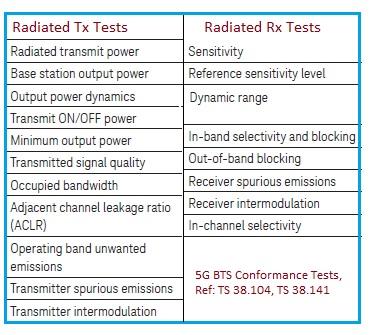
5G Base Stations are classified into various types, including type 1-C, type 1-H, type 1-O, and type 2-O. These classifications are based on the distances from the 5G UE, as specified in 3GPP 38.104. These 5G BTSs are tested across different frequency bands, channel bandwidths (5MHz, 10MHz, 15MHz, 20MHz, 25MHz, 30MHz, 40MHz, 50MHz, 60MHz, 80MHz, 100MHz), and subcarrier spacing (15KHz, 30KHz, 60KHz) in line with 3GPP documentation.
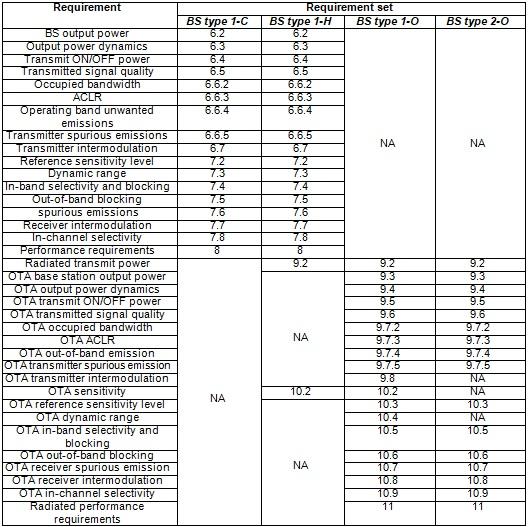
Detailed test cases used for 5G base station conformance testing, as published in TS 38.104, can be found in the following table. Additional OTA measurements performed during the R&D phase include 2D/3D beam pattern measurements, cross-polar isolation measurements, and beam-steering or null-steering performance evaluation.
Several companies are developing 5G OTA (Over-The-Air) test solutions and conformance test equipment, including:
Advertisement
Measurements
/Wireless
This article explores 5G UE conformance testing, covering RF, RRM, and OTA tests, and the equipment used to ensure devices meet 3GPP standards.
Measurements
/Wireless
This article covers the fundamentals of GSM conformance testing, including physical layer, radio, and tools used for testing.
Equipments
/Networking
Overview of data communication test equipment (pattern generators, BER testers, TDR testers, protocol analyzers) and common tests like eye diagrams, noise margin, and BER measurements.