
Equipments
/Electronics
Understanding Bit Error Rate (BER) and BER Testers
Explore the fundamentals of Bit Error Rate (BER) and Bit Error Rate Testers. Learn about measurement techniques and available equipment.
3 min read
Advertisement
Table of Contents
This article explores the concepts of Bit Error Rate (BER) and Packet Error Rate (PER), two crucial metrics for evaluating the performance of digital communication systems, both wired and wireless. These systems often face challenges like noise, jitter, interference, and I/Q imbalances that can degrade signal quality. BER and PER help us quantify these degradations and assess the reliability of our data transmission.
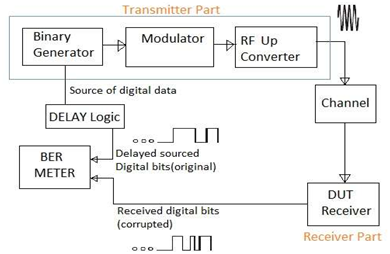
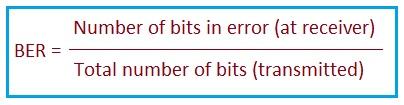
Let’s say we transmit a sequence of bits: [1 1 1 0 1 0 1 0 1 1 0]
If the received bits are [1 1 0 0 1 1 1 0 0 1 0], there are 3 errors.
Therefore:

The following equation demonstrates the mathematical relationship between BER and PER, assuming an ideal communication system over a binary symmetric channel with uncorrelated noise:
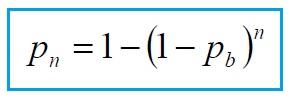
In the formula:
PER is determined by the BER and the number of bits within a packet’s data payload. It does not depend on data encoding methods or the transmit-receive process.
The relationship can be expressed as:
PER = 1 - (1 - BER)^n^
In summary, the fundamental difference between BER and PER is that BER focuses on individual bits, while PER is concerned with entire packets. However, both are interrelated, as shown in the formula above, and they are both important measures for assessing the quality and reliability of digital communication systems.
Advertisement
Equipments
/Electronics
Explore the fundamentals of Bit Error Rate (BER) and Bit Error Rate Testers. Learn about measurement techniques and available equipment.
Terminology
/General
This article explains the concepts of Noise Spectral Density (N₀) and Carrier-to-Noise Spectral Density Ratio (C/N₀), detailing their definitions, formulas, and applications.
Equipments
/Networking
Overview of data communication test equipment (pattern generators, BER testers, TDR testers, protocol analyzers) and common tests like eye diagrams, noise margin, and BER measurements.