
Equipments
/Wireless
WLAN Test and Measurement Equipments
Overview of WLAN test equipment including RF testers (VSG, VSA) and protocol analyzers for conformance and pre-certification testing.
4 min read
Advertisement
Table of Contents
This article explores the world of fading testing and measurement, covering the equipment used to simulate and analyze fading conditions. We’ll delve into what fading is, the different types, and the tools used by leading test solution providers to tackle this challenge.
Introduction:
Fading refers to the fluctuations in the strength of a received signal over time, caused by various impairments along the transmission path. Several factors contribute to this phenomenon, including:
There are different types of fading, broadly categorized as large-scale fading and small-scale fading. Small-scale fading is further divided into:
For a deeper dive into the basics and types of fading, refer to resources on “Fading basics and types” in wireless communication.
The core setup for fading measurement, regardless of the specific type of fading, remains largely the same, although the settings will vary.
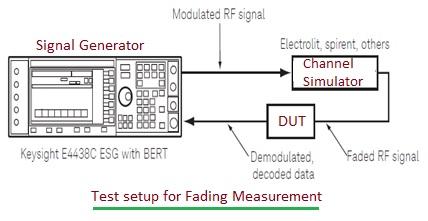
Here are some examples of fading test equipment from prominent vendors:
| Fading Test Equipment | Description |
|---|---|
| EB Propsim F8 Channel emulator | Company: Elektrobit Offers MIMO OTA (Over the Air) testing. Supports frequencies from 220 MHz to 6 GHz with a bandwidth of about 125 MHz. Supports up to 16 fading channels and up to 24 fading paths per channel. OTA antenna configurations: From 3 to 48 antennas in single polarized mode and 6 to 96 antennas in dual polarized mode can be configured. |
| SR5500 Channel emulator | Company: Spirent Communications Supports LTE, GSM, GPRS, EDGE, WCDMA, HSPA, HSPA+, CDMA20001X, EV-DO, WiMax (802.16d, 16e) etc. Supports SISO, MIMO, SIMO, MISO and beamforming. Supports frequencies in different ranges with a bandwidth of about 26 MHz. The RF input level can be changed from +5 dBm to -50 dBm. The RF output level can be changed from -20 to -110 dBm. Supports configurations of up to 24 paths per channel, with path delay from 0 to 2000 µS and path loss from 0 to 32 dB. Supports real-time fading models with the provision to configure fading velocity, type (Rician, Rayleigh, Doppler), etc. |
| ACE 400WB Channel emulator | Company: Azimuth Systems Supports 32 channels with 20 taps per channel. Provides the ability to configure Doppler shift, delay spread, path delay, RF frequency, bandwidth, attenuation, etc. |
Other notable companies like Keysight Technologies, Octoscope, NI, and R&S also develop channel simulators or emulators used for fading testing.
Besides channel emulators, fading tests also require standard-compliant signal generators, tailored to the DUT’s specific test requirements. Companies like NI, Keysight, R&S, Anritsu, and Litepoint are key players in developing Vector Signal Generators (VSG) and Vector Signal Analyzers (VSA) used for generating and analyzing signals.
Advertisement
Equipments
/Wireless
Overview of WLAN test equipment including RF testers (VSG, VSA) and protocol analyzers for conformance and pre-certification testing.
Articles
/Wireless
This article covers the fundamentals of VSAT testing, from module-level analysis to system-level performance and field troubleshooting, including common issues and solutions.
Articles
/Electronics
This article explores mobile phone hardware components, common faults, and troubleshooting methods. It covers essential tools, repair techniques, and problem-solving strategies.