
Terminology
/General
Period vs. Frequency: Understanding the Difference
Explains the concepts of period and frequency in alternating waveforms, their relationship, and how to convert between them.
2 min read
Advertisement
Table of Contents
This article explains how frequency is measured, including the units used and the equipment involved.
Frequency refers to the number of cycles or periods of a waveform (such as voltage or current) that occur in one second. For instance, if a waveform completes 5 cycles in a second, we say its frequency is 5 Hertz (Hz).
The fundamental unit for measuring frequency is the Hertz (Hz), which is equivalent to cycles per second. For convenience, especially when dealing with very high frequencies, we use the following multiples of Hertz:
These larger units make it easier to express and understand frequency measurements for signals with very rapid oscillations.
Here’s a look at the common devices used to measure frequency:
While an oscilloscope primarily displays time on the horizontal (X) axis and amplitude on the vertical (Y) axis, it can also be used for frequency measurements. Real-time oscilloscopes can convert the X-axis to represent the frequency domain, providing a frequency reading after you’ve set an appropriate frequency range.
A frequency counter is a dedicated instrument designed to display frequency numerically, showing the reading in digits based on its resolution.
An RF spectrum analyzer displays frequency along the X-axis and power along the Y-axis. To measure frequency, you can use markers to identify the peak in the waveform. The frequency value at the peak is displayed once you’ve configured the analyzer with the correct frequency range.
The image below illustrates a typical setup for frequency measurement:
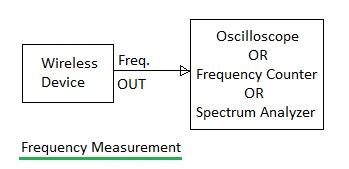
As shown, the output from the Device Under Test (DUT) is connected to one of the frequency measurement devices listed above. During the measurement, you will need to configure either the frequency range or the center frequency and bandwidth on the instrument to obtain accurate readings.
Advertisement
Terminology
/General
Explains the concepts of period and frequency in alternating waveforms, their relationship, and how to convert between them.
Measurements
/General
Explore the differences between time and frequency domain signal analysis, the parameters measured, and instruments used in each method.
Articles
/General
Explore the benefits and drawbacks of spectrum analyzers, essential tools for frequency domain analysis, including swept, FFT, and real-time models.