
Terminology
/Optics
Understanding Vertical Eye Closure Penalty (VECP)
This article explains VECP, a critical parameter in optical communication, used to quantify signal distortion under stress.
3 min read
Advertisement
Table of Contents
This article delves into the concept of TDECQ (Transmitter Dispersion and Eye Closure), a crucial metric in the world of optical communication. We’ll explore its definition, its formula, and how it’s used to assess the quality of transmitted optical signals.
Traditionally, eye mask analysis was used to gauge the quality of optical signals. However, a new metric called TDECQ has emerged as a more comprehensive way to characterize transmitted and received signals in the optical domain.
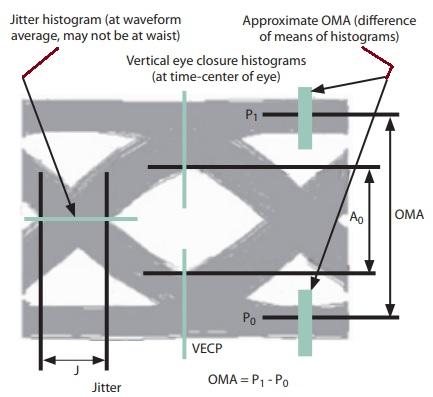 The image above shows an example of a stressed eye diagram, highlighting some of the parameters that affect signal quality in optical transmission, for both PAM4 and NRZ optical receivers.
The TDECQ is calculated using the following formula:
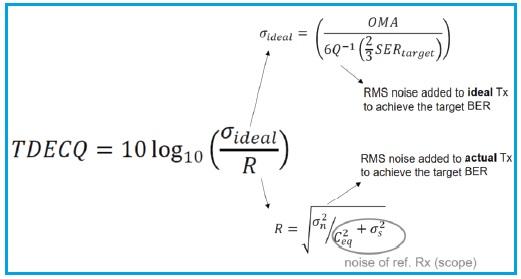
Here’s a breakdown of each component:
The measurement of TDECQ involves a conformance test setup, which typically includes the following:
 The figure above shows a block diagram for the TDECQ conformance test.
In summary, TDECQ provides a more robust evaluation of optical transmitter performance by considering not just the ideal signal but also how it degrades under realistic channel conditions. This metric is essential for ensuring reliable high-speed optical communication.
Advertisement
Terminology
/Optics
This article explains VECP, a critical parameter in optical communication, used to quantify signal distortion under stress.
Terminology
/Optics
This article explains Stressed Receiver Sensitivity in optical communications, its importance in power budget calculations, and the factors that affect it.
Terminology
/Optics
This article defines Optical Modulation Amplitude (OMA) and explains how it's calculated using formulas involving average power and extinction ratio.