
Terminology
/General
Advantages and Disadvantages of Digital Multimeters
Explore the benefits and drawbacks of digital multimeters (DMMs), essential tools for measuring voltage, current, and resistance in electronics.
2 min read
Advertisement
Table of Contents
Multimeters are essential tools for anyone working with electronics, and they come in two primary types: analog and digital. This article will compare and contrast these two types, highlighting their differences and respective strengths.
As depicted in Figure 1, an analog multimeter uses a needle that moves across a calibrated scale to display measurements. These measurements can include voltage (V), current (I), or resistance (R), and the device must be set appropriately for either AC or DC sources.
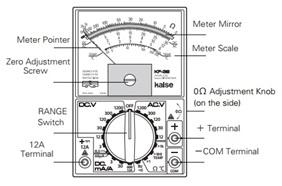
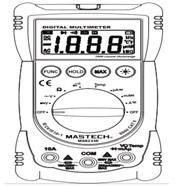
Figure 2 shows a typical digital multimeter, which features an LCD display panel and a rotating knob for selecting measurement types. Digital multimeters display readings as numerical values on the LCD screen. They use a variety of techniques to measure AC/DC voltage, resistance, and current, often without the need for manual range settings.
Here’s a detailed comparison of analog and digital multimeters in a tabular format:
| Feature | Analog Multimeter | Digital Multimeter |
|---|---|---|
| Display Type | Analog with a metal pointer on a calibrated scale | Digital numerical display on an LCD screen |
| Measurement Output | Analog form using a needle | Digital form using numerical digits |
| Measurable Parameters | Current, voltage, resistance | Current, voltage, resistance, and impedance |
| Display Complexity | Simple scale markings for different measurement ranges | LCD display showing numerical readings |
| A/D Converter | Does not require an Analog-to-Digital Converter | Requires an ADC to convert analog signals to digital |
| Measurement Accuracy | Lower accuracy | Higher accuracy |
| Input Resistance | Varies depending on the measurement range | Constant across all measurement ranges |
| AC Frequency Limit | Lower maximum AC frequency that can be measured | Higher maximum AC frequency that can be measured |
Both analog and digital multimeters have their own advantages and are suitable for different tasks. Understanding their differences can help you choose the right tool for your specific needs.
Advertisement
Terminology
/General
Explore the benefits and drawbacks of digital multimeters (DMMs), essential tools for measuring voltage, current, and resistance in electronics.
Articles
/General
This article compares analog and digital instruments, detailing their key features, differences, and examples.
Articles
/Electronics
Explore the differences between analog and digital sensors, their applications, and real-world examples.