
Articles
/Measurements
Advantages and Disadvantages of Thermocouples
Explore the pros and cons of thermocouples for temperature measurement, including their ruggedness, wide range, and non-linearity.
2 min read
Advertisement
Table of Contents
This article explores the differences between the Seebeck, Peltier, and Thomson effects, all of which are thermoelectric phenomena. These effects are fundamental to how thermocouples, which are common temperature measurement devices, operate.
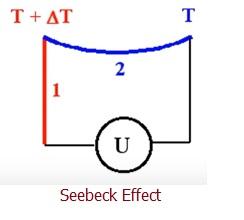
The Seebeck effect describes the creation of an electromotive force (EMF), or voltage, in a circuit made of two different metals when their junctions are kept at different temperatures. Imagine you have two different conductors, labeled conductor-1 and conductor-2. If conductor-1 is held at a temperature of ‘T+ΔT’ while conductor-2 is at ‘T’, this temperature difference will cause a voltage, denoted as ‘U’, to flow within the circuit.
The magnitude of this voltage (ΔV) is directly related to the temperature difference (ΔT) and a property of the materials called the Seebeck coefficient (S). This relationship is expressed as:
ΔV = S * ΔT12
Where:
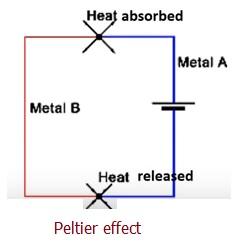
The Peltier effect is the reverse of the Seebeck effect. When an electric current flows through a circuit made of two different conductors, heat is either absorbed or released at the junction of those conductors. The direction of the current dictates whether heat is absorbed or released. This effect forms the basis for thermoelectric cooling devices.
The Thomson effect comes into play when an electrical current passes through a material that has a temperature gradient within it. In this situation, heat will either be absorbed or generated. The amount of heat is directly proportional to both the electric current and the temperature gradient.
The thermoelectric effect is the direct conversion of temperature differences into electrical voltage and vice versa. These effects are harnessed in various applications. Good thermoelectric materials need to exhibit:
Some materials that fit this profile include:
Advertisement
Articles
/Measurements
Explore the pros and cons of thermocouples for temperature measurement, including their ruggedness, wide range, and non-linearity.
Terminology
/General
Explore the fundamental differences between active and passive sensors, including their working principles, applications, and advantages.
Calculators
/General
Learn about the Temperature Coefficient of Resistance with a calculator and formula explanation. Understand how material resistance changes with temperature.