
Measurements
/Optics
Understanding TDECQ: Transmitter Dispersion and Eye Closure
This article explains TDECQ, a critical metric for evaluating optical signal quality. It details the formula, measurement process, and importance of TDECQ.
2 min read
Advertisement
Table of Contents
This article explains the concept of VECP (Vertical Eye Closure Penalty), a crucial parameter in the optical domain. We’ll explore its definition, how it’s used, and the formula involved in its calculation.
VECP, or Vertical Eye Closure Penalty, is a test parameter used in the calibration process. Specifically, it’s used to calibrate a reference TP3 signal for a Device Under Test (DUT). This is particularly important when measuring the DUT’s sensitivity to stress.
Think of it as a way to quantify how much “closed” or distorted an eye diagram becomes under stress.
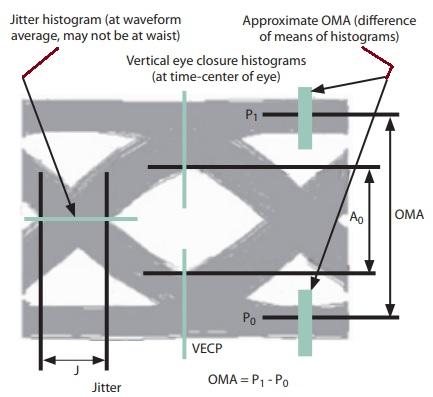 The image above shows a stressed eye diagram, highlighting the parameters like A0 and OMA used in VECP measurement.
The VECP isn’t just a concept; it’s calculated using a specific formula:
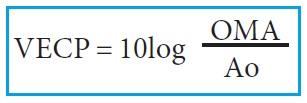
Here’s a breakdown of what each part of the formula means:
In essence, the VECP formula is comparing the size of the eye opening (A0) relative to the Optical Modulation Amplitude (OMA). This helps determine how significantly the signal is impacted under stress conditions.
By analyzing VECP, engineers can understand the robustness and performance of optical communication systems.
Advertisement
Measurements
/Optics
This article explains TDECQ, a critical metric for evaluating optical signal quality. It details the formula, measurement process, and importance of TDECQ.
Terminology
/Optics
This article defines Optical Modulation Amplitude (OMA) and explains how it's calculated using formulas involving average power and extinction ratio.
Terminology
/Optics
Explore the concept of optical responsivity, a key parameter in fiber optics, its formula, and its applications.