
Articles
/Automotive
Automotive Car Sensors: A Comprehensive Guide
Explore the function of automotive sensors, their types, and leading manufacturers. Learn how these devices impact safety, efficiency, and autonomous driving.
3 min read
Advertisement
Table of Contents
This article explores the differences between Air Fuel (AF) sensors and Oxygen (O2) sensors, commonly used in the automotive industry to regulate the air-fuel mixture in vehicles. We’ll delve into how each sensor works, their internal construction, and why they’re crucial for efficient engine performance.
As the names suggest, “O2” stands for Oxygen, and “AF” stands for Air Fuel. An AF sensor is essentially a modified version of the original oxygen sensor, often referred to as a wideband oxygen sensor due to its enhanced capabilities.
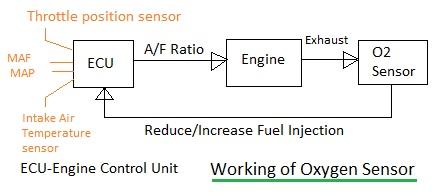
Figure 1: Working of an oxygen sensor.
The O2 sensor operates within a closed-loop system. The Engine Control Unit (ECU) takes inputs from various sensors like the throttle position sensor, MAF sensor, MAP sensor, and air temperature sensor. It then determines the air-fuel ratio, which should ideally be around 14.7. This mixture is present in the exhaust pipe where the O2 sensor is positioned. The O2 sensor monitors the oxygen content in the exhaust and relays this information back to the ECU. Based on this, the ECU adjusts the fuel injection to maintain the optimal air-fuel ratio.
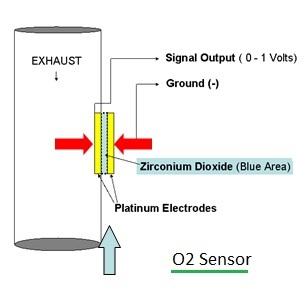
Figure 2: Internal construction of an O2 sensor.
The O2 sensor consists of two platinum electrodes separated by a zirconium dioxide element. As exhaust gas flows, it displaces the oxygen within the exhaust pipe. The platinum electrodes react to the difference in oxygen content between the outside air and the inside of the exhaust. This difference generates a small electrical current, or voltage. A typical O2 sensor produces 0.2 to 0.7 volts at around 600 degrees Fahrenheit. For a correct air-fuel mixture, the sensor generates about 0.5 volts. It will output over 0.5V for a rich mixture (too much fuel) and below 0.5V for a lean mixture (too much air).
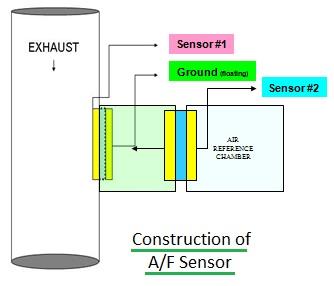
Figure 3: Internal construction of an Air Fuel Ratio sensor.
The AF sensor, a more advanced take on the original oxygen sensor, houses two O2 sensors in a single unit with a shared chamber between them. This wideband sensor adds two additional chambers to the standard zirconium sensor: a diffusion chamber and an air reference chamber.
Measurement Method: The primary difference lies in how these sensors measure the air-fuel ratio. The O2 sensor measures oxygen levels by producing a voltage, whereas the AF sensor measures the ratio by using a current.
Operational Current: The AF sensor uses minimal current for its operation.
Internal Complexity: The AF sensor has a more complex internal structure compared to the O2 sensor, with the addition of diffusion and air reference chambers, making it a wideband sensor capable of more precise readings.
In summary, both O2 and AF sensors play critical roles in maintaining optimal air-fuel mixtures in vehicle engines, ultimately affecting performance and emissions. While O2 sensors provide basic feedback based on voltage, AF sensors offer more sophisticated control with their current-based measurements and complex internal design. Understanding the differences between these sensors is key to understanding how modern vehicles achieve efficient combustion.
Advertisement
Articles
/Automotive
Explore the function of automotive sensors, their types, and leading manufacturers. Learn how these devices impact safety, efficiency, and autonomous driving.
Articles
/Medical
This article explores the benefits and drawbacks of pulse oximeters, crucial devices for monitoring blood oxygen levels.
Equipments
/Electronics
Explore the crucial role of gas sensors in detecting leaks, focusing on their construction, operation, and key manufacturers like Futurlec and Honeywell.