
Equipments
/Electronics
Oscilloscope: Advantages and Disadvantages
This article explores the pros and cons of analog and digital oscilloscopes, helping you understand their benefits and limitations.
2 min read
Advertisement
Table of Contents
Oscilloscopes are essential electronic instruments that visualize voltage waveforms. They display these waveforms over time, allowing us to analyze electrical signals. To connect a circuit’s test point to an oscilloscope, a probe is necessary. Just like other electronic devices, oscilloscopes come in both analog and digital varieties. Let’s explore the differences between these two types.
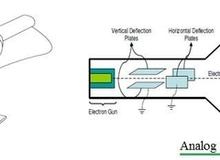 Fig:1 Analog Oscilloscope
Analog oscilloscopes, as their name suggests, operate using continuous variable voltages. The voltage being measured is directly applied to a moving electron beam inside the device. This voltage causes the beam to deflect, with the amount of deflection proportional to the voltage’s amplitude. The movement of the electron beam creates a trace on the screen of the oscilloscope.
These oscilloscopes are also known as Cathode Ray Oscilloscopes because they use a CRT. The CRT contains an electron gun that produces an electron beam. This beam then passes through a deflection system made of vertical and horizontal deflection plates.
The movement of the electron beam is governed by the polarity of the applied voltage:
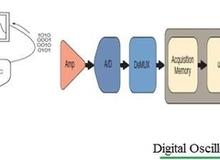 Fig:2 Digital Oscilloscope
Digital oscilloscopes, on the other hand, work with binary numbers (1s and 0s). These binary numbers represent voltage samples. A digital oscilloscope begins by reading an analog voltage waveform. It samples this waveform and then uses an Analog-to-Digital Converter (ADC) to convert the analog voltage into a digital form. This digital information is then used to construct the plot on the oscilloscope’s screen.
There are several types of digital oscilloscopes:
In summary, analog oscilloscopes directly display waveforms by deflecting an electron beam, while digital oscilloscopes sample the waveform, convert it to digital data, and then reconstruct the display. This fundamental difference in operation leads to various strengths and weaknesses for each type.
Advertisement
Equipments
/Electronics
This article explores the pros and cons of analog and digital oscilloscopes, helping you understand their benefits and limitations.
Articles
/Electronics
Explore the core differences between oscilloscopes and logic analyzers, highlighting their distinct uses and applications in electronic circuit analysis.
Equipments
/Electronics
Explore the differences between Digital Storage Oscilloscopes (DSO), Digital Phosphor Oscilloscopes (DPO), and Digital Sampling Oscilloscopes, and their specific applications.