
Articles
/Networking
IoT vs IoE vs M2M: Understanding the Differences
This article clarifies the distinctions between IoT, IoE, and M2M, explaining their unique scopes and applications in interconnected technology.
3 min read
Advertisement
Table of Contents
This article explores the distinctions between modems and routers, two essential pieces of hardware for internet connectivity. We’ll break down their individual functions, compare them in a table, and highlight how they work together (and sometimes as one!) to get your devices online.
A modem’s primary job is to connect you to the internet. Think of it as the translator between your home network and your Internet Service Provider (ISP). It takes the signals coming from your ISP (whether that’s via a phone line, cable, or fiber optic) and converts them into a format your devices can understand.
Here’s a breakdown of a modem’s functions:
 Figure 1: A typical WiFi modem from TP-Link.
A router takes the single internet connection provided by your modem and extends it to multiple devices within your home or office. It’s the traffic controller of your local network, directing data to the correct device.
Here’s what a router does:
 Figure 2: A typical N300 Wi-Fi Router from NETGEAR.
For added convenience, devices that combine the functions of both modems and routers are readily available. These are commonly known as MiFi routers. They connect to a cellular network (2G/3G/4G/5G) and then use WiFi to provide internet to multiple devices, such as laptops, tablets, and smartphones.
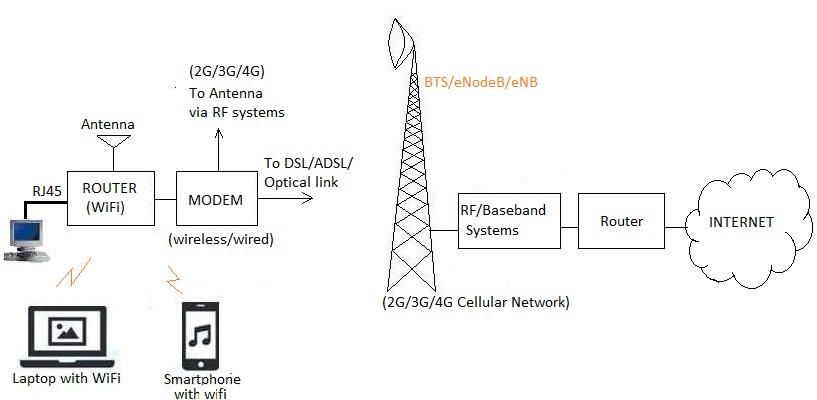
Let’s summarize the key differences between modems and routers in a table:
| Feature | Modem | Router |
|---|---|---|
| Cellular Connectivity | Yes | No |
| Wired Broadband Connectivity | Yes (DSL, ADSL, Cable, Optical) | No |
| Layer 3 (IP) and Above | No | Yes |
| Physical & MAC Layer | Yes | No |
| IP Server Connectivity | No | Yes |
To have a working internet connection and the ability to share it across multiple devices, you typically need both a modem and a router. Nowadays, many devices combine the functions of both for ease of use. MiFi routers are a great example, providing a convenient way to connect via cellular networks and then broadcast Wi-Fi. These types of routers are becoming increasingly popular due to their flexibility and built-in modem functionalities.
Advertisement
Articles
/Networking
This article clarifies the distinctions between IoT, IoE, and M2M, explaining their unique scopes and applications in interconnected technology.
Articles
/Networking
A comparison of CAT5, CAT5e, CAT6, and CAT6A Ethernet cables, detailing their speeds, bandwidth, and ideal use cases.
Articles
/Wireless
An overview of WiFi testing, covering radio conformance, protocol conformance, and interoperability. Essential for WLAN device manufacturers and software developers.