
Articles
/Optics
Image Intensifier vs. Thermal Imager: A Detailed Comparison
A comparison of image intensifier and thermal imager technologies, highlighting their principles, applications, and differences.
4 min read
Advertisement
Table of Contents
This page describes the basics of night vision and various night vision equipments or devices, along with their applications and benefits. We’ll cover devices like night vision goggles, binoculars, monoculars, and scopes.
Night vision refers to the ability to see in low-light conditions. This isn’t naturally possible for human beings without assistance. We require night vision devices to see in these environments.
Our ability to see in low light depends on two key factors: a sufficient spectral range and a sufficient intensity range. Humans have limitations in both these areas, which is why we struggle to see in the dark. However, technology can enhance these parameters, allowing us to see in low light.
There are two primary approaches to night vision:
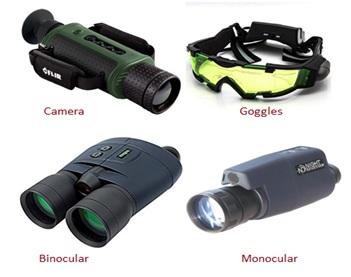
Night vision equipment and devices are employed in a wide range of applications, including military operations, law enforcement, hunting, surveillance, navigation, security, and wildlife observation.
These devices are also used by private detectives, firefighters, hunters, and nature enthusiasts. They are primarily constructed using image intensifier tubes. Here are some of the most popular types:
Night Vision Goggles: These opto-electronic devices allow images to be produced even in total darkness.
Night Vision Cameras: These cameras enhance video images in low light conditions, providing improved security. They’re widely used for surveillance and security applications, especially for around-the-clock monitoring, both indoors and outdoors. With the help of IR illumination, these cameras can be used effectively in near-total dark conditions. They are often referred to as “24 x 7 cameras” due to their continuous operation. They’re commonly available in dome and bullet shapes.
Night Vision Binoculars: These allow you to use both eyes to view distant images as if they were much closer. This provides a 3D image, which offers numerous advantages to the user. Think of them as two mini-telescopes for each eye.
Night Vision Monocular: This is essentially one side of a pair of binoculars. It’s also known as a mini-telescope or a tiny spotting scope.
Night Vision Scope: This electro-optical device provides visible images in low light conditions, typically at night. It uses visible and infrared energy for its operation. They can only be used at night and not during the day. This is the primary disadvantage of night vision scopes.
Following are some of the advantages of night vision equipments/devices.
Night Vision Equipment plays a critical role in security, military, wildlife observation, and navigation, providing enhanced vision in low light and dark environments. Its ability to detect heat signatures, improve situational awareness and ensure safety makes it invaluable for law enforcement, search and rescue, personal security and tactical applications. With ongoing technological advancements, night vision devices continue to improve in performance, affordability, and accessibility, expanding their use in both professional and civilian sectors.
Advertisement
Articles
/Optics
A comparison of image intensifier and thermal imager technologies, highlighting their principles, applications, and differences.
Equipments
/Electrical
Explore the fundamentals of thermal cameras, their specifications, and a list of leading manufacturers, focusing on applications in electrical inspections.
Articles
/General
Explore the differences between microscopes and telescopes, focusing on their purposes, magnification, and typical applications.