
Measurements
/Flow
Vortex vs. Turbine Flow Meters: A Detailed Comparison
A detailed comparison of vortex and turbine flow meters, exploring their operating principles, features, and advantages for flow measurement.
3 min read
Advertisement
Table of Contents
When it comes to measuring the flow of liquids in pipes, both mechanical and magnetic flow meters are popular choices. While they both achieve the same goal, they operate on fundamentally different principles. Let’s dive into a comparison of these two types of flow meters.
Mechanical flow meters, as the name suggests, utilize moving parts to measure flow. These meters often employ a turbine, paddle, or wheel that rotates as fluid passes through the pipe.
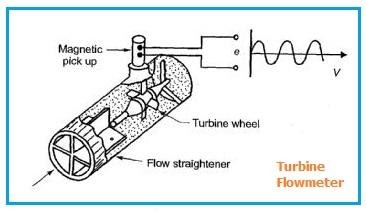 Turbine Flowmeter
The rotation of the internal component is directly proportional to the velocity of the fluid. Once the velocity is determined, the volumetric flow rate can be calculated by considering the cross-sectional area of the pipe. A common example is the turbine flow meter, as shown in the image above.
Magnetic flow meters, also known as electromagnetic flow meters, utilize electromagnetic principles to measure the flow of conductive liquids.
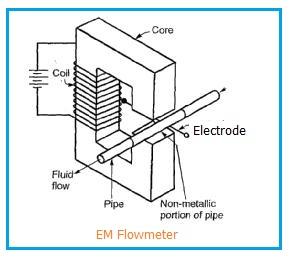 Electromagnetic, EM Flowmeter
These meters employ Faraday’s law of electromagnetic induction. A coil assembly generates a magnetic field across the pipe. When a conductive fluid flows through this magnetic field, it induces a voltage. This voltage is directly proportional to the velocity of the fluid, which allows for the calculation of the flow rate.
| Feature | Mechanical Flow Meter | Magnetic Flow Meter |
|---|---|---|
| Principle | Moving parts (turbine, etc.) | Electromagnetic induction |
| Fluid Type | Wide range of liquids | Conductive liquids only |
| Clogging Risk | High risk due to solids | Low risk |
| Maintenance | Moving parts require attention | Generally low maintenance |
| Suitability | Versatile, but needs clean fluid | Ideal for wastewater, aqueous solutions |
In conclusion, the choice between a mechanical and magnetic flow meter depends largely on the specific application and the type of fluid being measured. Mechanical meters are versatile but require clean fluids, while magnetic meters are ideal for conductive liquids, particularly wastewater. By understanding their differences, you can select the right meter for your needs.
Advertisement
Measurements
/Flow
A detailed comparison of vortex and turbine flow meters, exploring their operating principles, features, and advantages for flow measurement.
Measurements
/Flow
Explore the benefits and drawbacks of electromagnetic flowmeters, including their ability to handle slurries and conductive liquids, along with limitations due to conductivity requirements.
Measurements
/General
Explore the fundamental differences between mass flow meters and volume flow meters, their applications, and key characteristics.