
Equipments
/RF
Network Analyzer: Advantages and Disadvantages
Explore the pros and cons of Scalar (SNA) and Vector (VNA) Network Analyzers for transmission and reflection measurements.
2 min read
Advertisement
Table of Contents
This article delves into the fundamental measurements of S-parameters, namely S11, S12, S22, and S21. We’ll explore the setup used for these measurements and what these parameters reveal about a device under test (DUT).
A vector signal contains both amplitude and phase information. When such a signal passes through a device (our DUT), its characteristics change. The output signal’s amplitude and phase will differ from the input. S-parameters capture these changes, providing insights into both amplitude and phase shifts.
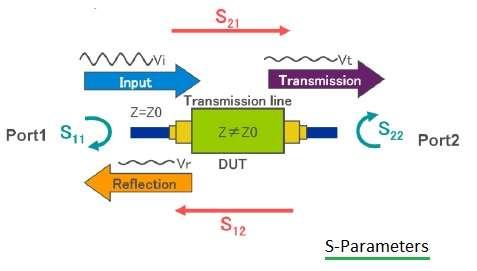
Essentially, S-parameters are a complex matrix used to analyze the reflection and transmission characteristics of a device in the frequency domain. Amplitude variations tell us about insertion loss, while phase variations reveal phase shift.
For a two-port device, there are four S-parameters. The naming convention is “S” followed by two digits. The first digit indicates the output port, and the second indicates the input port. For instance, S21 means the output is measured at Port 2, with the input signal applied at Port 1.
S-parameter measurements can be categorized as:
These parameters provide information about:
These parameters provide information about:
A Vector Network Analyzer (VNA) is the tool used to measure S-parameters.
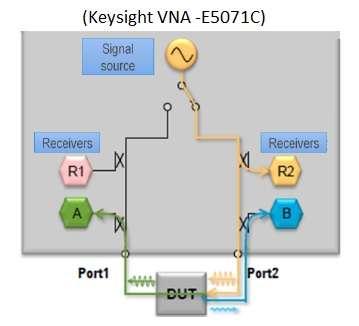
The VNA internally measures both amplitude and phase using four receivers (R1, R2, A, and B).
Here’s how each S-parameter is derived:
In essence, S-parameters give us a complete picture of how a signal behaves when it interacts with a device, which is crucial in RF and microwave engineering.
Advertisement
Equipments
/RF
Explore the pros and cons of Scalar (SNA) and Vector (VNA) Network Analyzers for transmission and reflection measurements.
Terminology
/General
A glossary of common terms used with network analyzers, including transmission coefficient, insertion loss, gain, reflection coefficient, return loss, and S-parameters.
Measurements
/RF
A guide to RF coupler testing, covering key parameters like coupling, directivity, insertion loss, and test setups. Learn how to measure these specifications.