
Measurements
/General
Frequency Measurement: Understanding the Basics
Learn about frequency measurement, including units like Hertz, and the equipment used such as oscilloscopes and spectrum analyzers.
3 min read
Advertisement
Table of Contents
Many alternating voltages and currents we encounter change periodically over time. This means their waveforms, whether voltage (V) or current (I), exhibit regular, repeating patterns. Think of it like a wave – it goes up and down, and then repeats that same up-and-down motion again and again as time moves forward. One complete up-and-down cycle is known as a “cycle”.
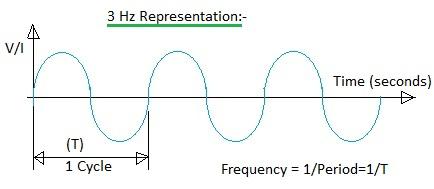
Frequency essentially tells us how many of these cycles occur within a single second. It’s a measure of how quickly the waveform is repeating itself. The unit for frequency is called Hertz, abbreviated as Hz. You might have also heard it referred to as cycles per second, which is the same thing.
For instance, if a waveform completes 3 cycles in one second, we say its frequency is 3 Hz. A common example is the AC power supply in most countries, which has a frequency of 50 Hz. This means the waveform repeats itself 50 times every second.
Period, on the other hand, measures the time it takes for just one complete cycle to occur. It’s the duration of a single repetition of the wave.
Period and frequency are closely linked, and their relationship is defined by a simple equation:
Time Period = 1 / Frequency
Let’s use the 50 Hz power supply example again. If the frequency is 50 Hz, the period is 1/50 of a second, which is equal to 0.02 seconds. So, each cycle lasts for 0.02 seconds.
While not directly related to period and frequency, it’s worth briefly mentioning amplitude. Amplitude, or peak value, refers to the maximum or minimum value of the alternating quantity (voltage or current). It’s essentially the “height” of the wave.
We often categorize frequencies into different ranges based on their values:
We also use larger units of frequency, especially when dealing with high values:
Here are some handy calculators to help you convert between period and frequency:
Calculator-1:
Example #1:
Calculator-2:
Example #2:
These calculators make it easy to switch back and forth between these two related concepts!
Advertisement
Measurements
/General
Learn about frequency measurement, including units like Hertz, and the equipment used such as oscilloscopes and spectrum analyzers.
Terminology
/General
This article explains the difference between range and span in measurement instruments, using examples like thermometers and spectrum analyzers.
Measurements
/General
Explore the differences between time and frequency domain signal analysis, the parameters measured, and instruments used in each method.