
Terminology
/General
Sensor vs. Transducer: Key Differences Explained
Understand the difference between sensors and transducers, their roles in measurement, and how they often work together to convert energy forms.
3 min read
Advertisement
Table of Contents
When we talk about transducers, we’re referring to devices that convert one form of energy into another. In many measurement systems, this conversion often happens in stages. This is where the concepts of primary and secondary transducers come into play. Let’s break down the difference between these two types.
A primary transducer is the device that directly interacts with the physical quantity being measured. It converts this physical quantity into a mechanical displacement or deformation. Think of it as the first step in the transduction process.
A secondary transducer takes the output of the primary transducer (typically a mechanical displacement) and converts it into an electrical signal. This electrical signal is often easier to process, transmit, and display. It’s the bridge from mechanical movement to a measurable electronic output.
Think of a traditional weighing scale:
As illustrated in the image below, transducers can be classified in several ways, including:
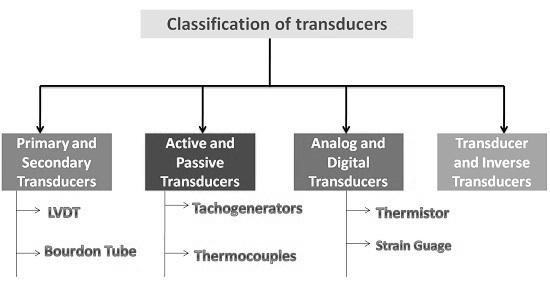
| Feature | Primary Transducer | Secondary Transducer |
|---|---|---|
| Conversion | Physical quantity to mechanical motion | Mechanical motion to electrical signal |
| Primary Nature | Mechanical | Electrical |
| Role | Initial detection and conversion | Conversion to usable signal |
| Examples | Bourdon tube, diaphragm, bellows | LVDT, strain gauge, capacitance sensor |
In summary, primary transducers are the front line of measurement, directly sensing the physical quantity, while secondary transducers convert the resulting mechanical motion into electrical signals that can be further processed and interpreted. Together, they form the backbone of many measurement systems.
The primary difference between primary and secondary transducers lies in their method of signal conversion:
Understanding these distinctions helps in selecting the appropriate transducer for applications in automation, medical devices and industrial measurement systems.
Advertisement
Terminology
/General
Understand the difference between sensors and transducers, their roles in measurement, and how they often work together to convert energy forms.
Terminology
/General
Explore the fundamental differences between analog and digital transducers, their working principles, and examples.
Terminology
/General
Explore the fundamental differences between active and passive transducers, including their power requirements, output signals, and examples.