
Terminology
/General
Lux vs Lumens: Understanding the Difference
This article explains the difference between lux and lumens, two key measurements in lighting, and how they relate to light intensity and total light output.
2 min read
Advertisement
Table of Contents
This article explores the concept of lux, also known as illuminance, and provides charts outlining recommended light levels for various indoor and outdoor environments. Illuminance refers to the amount of light falling on a surface, and it’s a crucial factor in creating comfortable and functional spaces.
Illuminance, or light level, measures the total luminous flux (light) incident on a surface per unit area. Think of it as how much light is actually hitting a particular spot. It’s commonly measured in:
Here’s how these units relate to each other:
The following table illustrates the illuminance levels provided by different natural light sources:
| Natural Source | Illumination (ftcd) | Illumination (lux) |
|---|---|---|
| Sunlight | 10,000 | 107,527 |
| Full Daylight | 1,000 | 10,752 |
| Overcast Day | 100 | 1,075 |
| Very Dark Day | 10 | 107 |
| Twilight | 1 | 10.8 |
| Deep Twilight | 0.1 | 1.08 |
| Full Moon | 0.01 | 0.108 |
| Quarter Moon | 0.001 | 0.0108 |
| Starlight | 0.0001 | 0.0011 |
| Overcast Night | 0.00001 | 0.0001 |
This chart provides recommended illuminance levels for various indoor environments:
| Light Levels Indoors | Illumination (Lux, Lumen/sq.m ) |
|---|---|
| Public areas with dark surroundings | 20 to 50 |
| Warehouses, Homes, Theaters | 150 |
| Easy Office Work, Classes | 250 |
| Normal office work, PC work, Study library, Groceries, Labs, Show rooms | 500 |
| Super markets | 750 |
| Mechanical workshops, normal drawing work | 1000 |
| Detailed drawing work | 1500 to 2000 |
| Visual tasks with low contrast & very small size for prolonged periods of time | 2000 to 5000 |
| Training rooms | 500 |
| Auditoria | 150 to 200 |
| Child care centers, Parking , entrances, physical fitness space | 500 |
The following image displays recommendations for light levels on roadways and sidewalks:
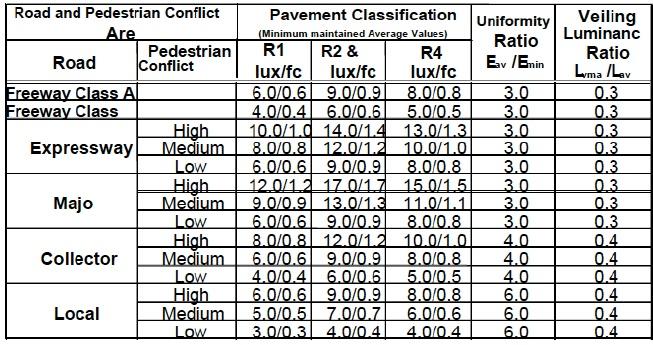
Lux and illuminance are crucial in determining the appropriate lighting levels for different spaces. While illuminance refers to the amount of light falling on a surface (measured in lux), different applications require specific lux levels for optimal visibility and comfort. For example, office spaces typically require 300 to 500 lux, while outdoor stadiums may need over 1000 lux. Understanding these values helps in selecting proper lighting solutions, improving energy efficiency, and ensuring safety in both residential and commercial settings.
Advertisement
Terminology
/General
This article explains the difference between lux and lumens, two key measurements in lighting, and how they relate to light intensity and total light output.
Terminology
/General
Explore the fundamentals of BGA packaging, including PBGA, CPBGA, CBGA, and TBGA types. Learn about their features, advantages, disadvantages, and applications.
Articles
/Medical
This article explores the benefits and drawbacks of pulse oximeters, crucial devices for monitoring blood oxygen levels.